
Imagination is no more a strategy in the cutthroat business world of today. To improve the result, lower risks, and make more informed decisions, successful brands depend on data-driven marketing. analyze behavior, monitor results, and optimize campaigns, companies now use real data rather than making assumptions about what customers want. The way marketing functions is changing as a result of this move from intuition to information.
You are missing out on growth opportunities if you continue to conduct campaigns using just imagination without evaluating performance. Let’s see how data driven marketing grows your online company using analytics.
What Is Data Driven Marketing?
Data-driven marketing is a strategic approach that combines information from multiple sources to obtain insights into customer behavior, tastes, and trends, resulting in personalized experiences for your target audience. First, pertinent data must be collected via market research, social media interaction, website analytics, and consumer interactions, among other sources. After that, this data is examined to find patterns, relationships, and trends that may offer you a better understanding of your clients.
These are the important questions:
- What is the most effective marketing channel for producing leads?
- What kind of material works best?
- Where are prospective clients being dropped off?
- Which advertisements yield the best ROI?
Marketing becomes more accurate and lucrative when you comprehend these responses.
Why Guesswork No Longer Works At Data Driven Marketing
Businesses made a lot of assumptions in the early days of marketing. A business may suppose that buyers preferred a certain product or think that a particular advertisement looked good.
Customers now communicate with brands via a variety of channels, including websites, social media, email, search engines, and advertisements. Data is produced with every encounter.
For example, if you have 20 conversations with 5,000 website visitors, the analytics will help you to find the problem.The call to action might not be clear. Perhaps customers are abandoning the pricing area. These issues stay undiscovered in the absence of data.
How Analytics Improves Marketing Performance
Measurable insights from analytics technologies increase the effectiveness of marketing. Platforms like Google Analytics allow businesses to track:
- Demographics of visitors
- Sources of traffic
- User conduct
- Spending time on pages
- Paths of conversion
Regular analysis of this data allows you to swiftly modify your approach.
For example:
- You can enhance targeting if social media traffic has a low conversion rate.
- You can write more relevant posts if your blog’s material generates a lot of interaction.
- You can narrow down your target if paid advertisements appear to be expensive but yield little return.
Campaign performance is improved and budget waste is decreased with data-driven marketing.
Better Audience Targeting In Data Driven Marketing
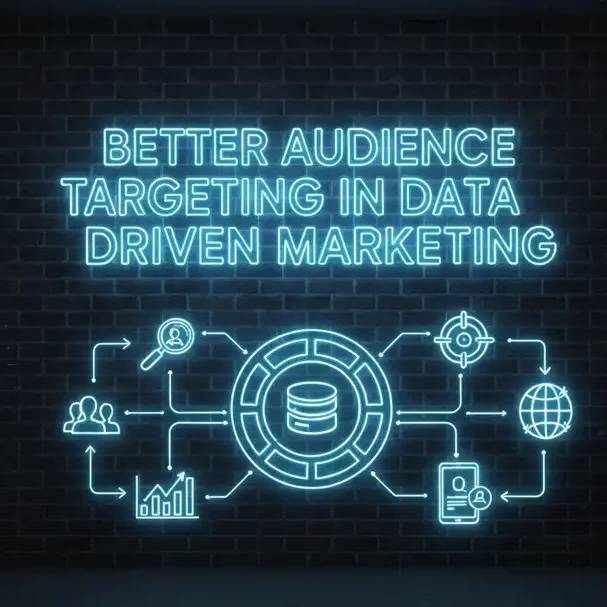
Accurate audience targeting is one of the main benefits of data-driven marketing.
Rather than advertising their goods to everyone, companies can find:
- Age ranges
- Places
- Interests
- Patterns of online conduct
Businesses can establish intricate audience groups using advertising platforms such as Meta Ads Manager. This guarantees that those who are most likely to convert see the adverts.
- Improved targeting entails:
- Reduced expenses for advertising
- Increased involvement
- A rise in sales
Reaching everyone is not as beneficial as reaching the right individuals at the right time.
Personalization Builds Stronger Customer Relationships
Personalized experiences are expected by modern consumers. Generic communications are frequently disregarded.
After businesses using analytics they can:
- Showing products using their browsing history
- Send customized email marketing campaigns.
- Show returning visitors pertinent advertisements
- Personalize website experiences
Customers feel understood when products are personalized. Trust grows when clients feel appreciated, and trust breeds enduring loyalty.
When businesses move bulk marketing to better communication with the help of data driven marketing.
Measuring Real ROI
Marketing expenditures ought to yield quantifiable results.However, it is difficult to know what is happening there without analytics.
By checking key performance indicators (KPIs) like:
- The price per lead
- Cost of acquiring new customers
- Rate of conversion
- Return on investment for advertising
- Businesses learn more about profitability.
You can make smart budget reallocations if one campaign brings in three times as much money as another. This guarantees that funds are allocated where they yield the greatest returns.
Marketing becomes an investment when it is data-driven.
Identifying Customer Behavior Patterns
Rarely are customer journeys linear. One could:
- Learn about your brand on social media.
- Go to your website.
- Go without making a purchase.
- Later, use a search engine to come back.
- After viewing a remarketing advertisement, finally convert
This trip is mapped with the use of analytics tools. Knowing these trends enables companies to design marketing funnels that are more successful.
Understanding how they navigate your digital ecosystem,it is helpful to improve your business travel.
Continuous Improvement Through Testing
Instead of making assumptions, data-driven marketing promotes testing.
For instance:
- Comparing and contrasting several headlines
- Two landing page designs are being tested.
- Contrasting various ad creatives
- A variety of call-to-action buttons
Instead of speculating about whether version performs better, data offers a definitive response.
Revenue can gradually rise significantly with even modest improvements in conversion rates.
Competitive Advantage:Data Driven Marketing
A lot of businesses continue to use conventional marketing techniques.Brands that keep a careful eye on performance and react fast to shifts get a distinct competitive edge.
Monitoring trends, engagement levels, and consumer replies allows you to respond faster than competitors.
Analytics can also assist identify new opportunities. For instance:
- Finding unexplored audience niches
- Identifying content concepts that perform well
- Recognizing patterns of seasonal demand
This proactive strategy keeps your company ahead of the competition.
The Role of AI in Data Analysis
Marketers are now able to analyze vast amounts of data more quickly because to artificial intelligence tools like Google AI systems and platforms like ChatGPT.
AI is capable of:
- Forecast consumer behavior
- Make suggestions for content enhancements
- Reporting should be automated.
- Determine trends
AI helps, but human strategy and interpretation are still crucial. Strategy provides data direction, but data itself is powerful.
Common Mistakes Happens In Data Driven Marketing
Data driven marketing is useful when it must be used perfectly.
Avoid these kind of mistakes:
- Too many indicators being tracked without any defined objectives
- Disregarding data insights
- concentrating solely on vanity metrics (followers and likes)
- Not frequently looking over analytics
Numbers have impact only when they drive change.
How to Start Using Data Driven Marketing
Start simple if analytics is new to you:
- Set specific marketing objectives.
- Monitor fundamental indicators like traffic and conversions.
- Make regular use of analytics tools
- Evaluate performance every month.
- Campaigns should be modified in light of insights.
Final Thoughts
In this digital world success is a very big step without making clarity on business based decisions.Data driven marketing helps to make decisions with confidence, understanding the audience, performance analysis. Instead of losing money and time on unwanted strategies.
Analytics makes a structured measurable growing system . It ensures that every campaign improves toward actual company objectives by highlighting opportunities and pointing out flaws. Data dependence is no longer a luxury as competition rises and consumer expectations change.
Companies that use data-driven marketing will see better outcomes and develop deeper, more meaningful connections with their clients. Ultimately, wise choices supported by genuine insights always result in long-term growth.